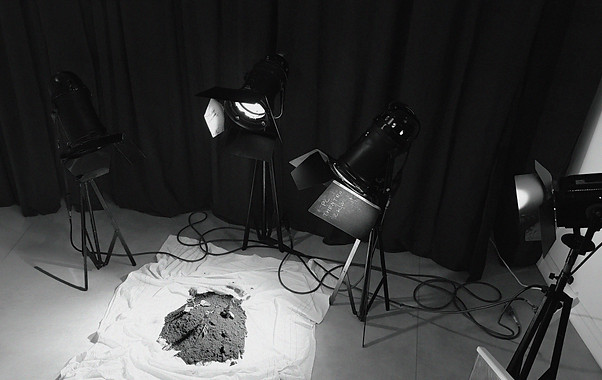
Soft Monuments II, conceptual and scenographic research, Paris, 2026
Soft Monuments II aims to develop the project as an active dispositif on stage, exploring the relationships between sound, costume, light, and scenographic objects. In this work, these elements are not conceived as mere symbolic supports, but as active agents that direct bodies, interrupt gestures, and organise the regime of visibility on stage.On stage, several women wear identical costumes and carry placards displaying tasks or first names. An external authoritarian voice continually alters their acts of care, interrupting their continuity. The narrative therefore does not progress in a linear manner; instead, it becomes fragmented through repetitions, commands, and interruptions. The fur ceases to function as a luxurious costume: it becomes an object that weighs upon the bodies, slows their movements, and makes labour, fatigue, and resistance physically visible. The spotlights, which usually organise visibility while remaining invisible themselves, become a burden carried by the women. The light they produce does not merely illuminate the stage; it also acts upon the material, accelerating the wilting of the flowers. Thus, without directly representing a specific historical event, the project explores the relationships between identity, labour, care, and visibility on stage as a political dispositif.